How to Beef Up Guitar Amp
Many people underestimate the importance of the electrical guitar in a mix.
They can make your mix thick, powerful, and heady. When mixed properly, they add a keen deal of emotion to the song.
Just when they're mixed wrong, they tin take up a ton of space. Rather than making a song more emotional, they can make it blander. More than apartment. More dirty.
This is specially true if you accept several guitar tracks happening at once. It's easy to have too many passengers crowding the train car!
To help you avoid all of these problems, here are seven tips for mixing guitars that you can apply today to brand your mixes sound split, clear, and exciting.
Do you lot want to make coin from your music?
You lot don't demand expensive gear, connections, or god-like noesis to kickstart your career.
This free Masterclass reveals the fundamental steps yous ACTUALLY need to make a reliable income doing what you love in 2021.
Take hold of the full Masterclass hither:
But if you just want to larn nigh Mixing Guitar specifically, proceed reading.
Guitar Mixing Tip #i: Never Solo.
Never. Never ever.
A mutual misconception is that an instrument has to audio beautiful past itself to audio beautiful in a mix. Makes logical sense, right? Why would something that sounds bad on its own make a mix ameliorate?
But that'southward non really how it works.
Think of information technology like cooking a dish. On their own, the ingredients might not taste that special. But when combined in but the right way, they enhance each other's flavors.
The dish is, as the old saying goes, "greater than the sum of its parts."
A mix is the same way! It's more important that the chemical element you add together enhances the overall mix rather than the element sounding gorgeous on its own.
Think: your listeners are never going to hear the guitar by itself. Only y'all will exercise that. All they'll ever hear is the song itself.
So make your mixing decisions in context of the rest of the song. Don't solo the track and apply guitar EQ or compression by itself. It may brand the instrument sound slap-up, merely it'll bring the rest of the track downward.
Now, of course, the obvious counter is this. "What if I can't hear that musical instrument? I don't want to be mixing blind."
And you're absolutely right to say this.
When you're mixing guitars and you lot can't hear them well…
…rather than soloing, simply turn it upwards. When you're done, plough it dorsum downwards.
You will nevertheless be able to hear the rest of the mix, and so you'll be making the right decisions in terms of the mix. It's the best of both worlds.
To make this easier, whenever I start a mix, I'll put a gain plugin with a +5dB boost on each of my tracks. When I need an instrument I'thou working on to be louder, I just appoint that plugin. When I'k done, I bypass information technology once again.

This allows you to temporarily alter the volume of the track, even if yous already take automation written in.
Make sure y'all put the gain plugin at the Stop of your plugin chain, though. Yous want your effects to stay the same one time you've turned the volume back down. Otherwise, all those mix decisions volition get pointless.
Bonus tip: Learn to employ gain automation. Your mixes will sound even more consequent.
Guitar Mixing Tip #2: If You Don't Need Information technology, Mute It.
A lot of people get carried away with overdubbing electric guitar chords.
The thought is that they will make the guitar audio thicker and heavier. But the more y'all overdub, the muddier it gets.
Separation is important with guitars. Separating v different electrical guitar parts all stacked on tiptop of each other is a difficult chore.
Truth be told, yous will really lose assailment and intensity if yous record too many guitar tracks. They start to fade into each other and sound messy and undefined.
And so don't be afraid to mute extra parts if they aren't adding anything.
This tip rings true for stereo-miked guitar parts as well. You don't have to keep every mic! That tin can actually become more of a problem. Audition each mic, and get rid of the ones you lot don't demand.
For thick choruses, having two guitar tracks is all you need. Try panning one rhythm guitar difficult left and panning another hard right.
Guitar Mixing Tip #3: Rest is Key.
Before yous reach for your EQ's and compressors, get your guitars to sit well in the mix.
Dorsum in the days before analog effects (pre-1950's), Sound Engineers were actually called Residue Engineers. Their entire job was simply to balance the loudness of the instruments that had been recorded.
It'due south the MOST important role of the mix, but it'due south besides the virtually overlooked.
Your guitars are never going to enhance the mix if they aren't balanced with the rest of the instruments. Before you lot start putting on any effects, take your fourth dimension to play with the volume. Find the exact spot they should be sitting. Then go started on your processing.
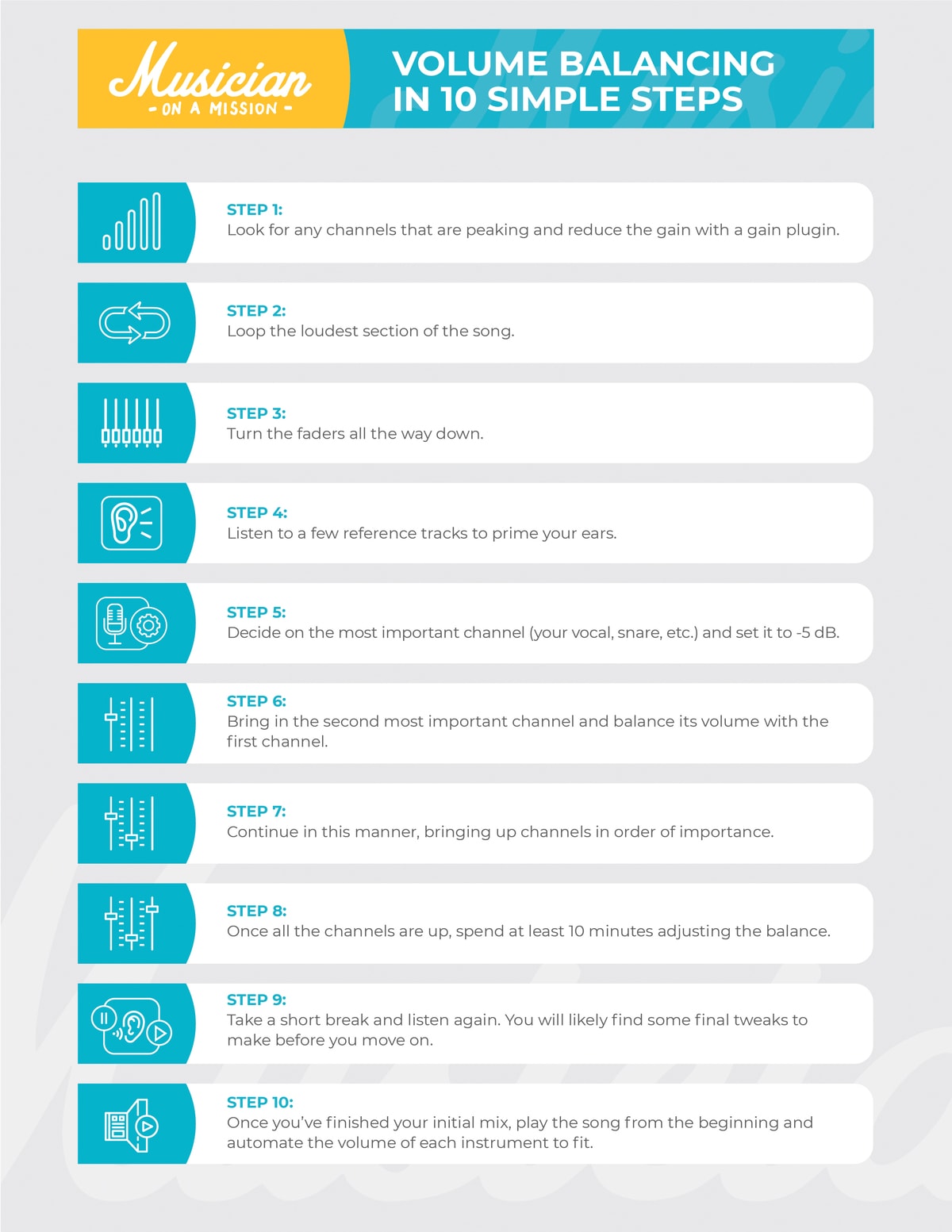
Even though this tip will have you lot more fourth dimension in the short term, information technology volition relieve you twice as much in the long term. Your processing will never sound proficient if the musical instrument is as well loud or besides soft.
Brand your job easier, and be a Remainder Engineer.
Guitar Mixing Tip #four: Bussing is Best.
Bussing is the 8th wonder of the world.
Many people underestimate the importance of the electric guitar in a mix. They can make your mix thick, powerful, and heady. When mixed properly, they add a corking deal of emotion to the song. Merely when they're mixed wrong, they can take up a ton of infinite. Rather than making a song more than emotional,
For those unfamiliar, bussing is when you lot send all of the recordings of a unmarried instrument to i aux channel. From there, whatsoever plugin you add together affects every one of those recordings.
Non only does information technology aid "mucilage" your tracks together, but information technology massively cuts downward on the amount of plugins you have to use to terminate a mix.
For example, if y'all have half-dozen electric guitar tracks, you would usually have to shrink each one (if they need it). Merely with an electric guitar buss, y'all only have to employ i compressor for the entire agglomeration.
This saves you on CPU, so your projects will exist less likely to crash as your mix gets big. Information technology'll likewise save yous massive amounts of time.
Bussing your guitars together makes yous think near where you lot want them to sit in the frequency spectrum. Practise you want them to be prominent in the low-mids? The upper-mids?
Your processing will exist spread beyond all of your guitar tracks, so yous are more likely to brand a better, more than intentional choice.
Guitar Mixing Tip #5: Don't Exist Agape to Cutting.
Electric guitars are like a loaf of staff of life.
Stay with me here…
The worst parts of whatsoever bread loaf are the heels. They're all crust, no fluff. Chewy and sometimes fifty-fifty a trivial biting.
I usually but throw them abroad after I go back from the market.
The same is true for your guitars. The ends are just unnecessary.
So throw them away.
The electric guitar is a very mid-range heavy instrument. You don't need the low finish, because the bass and kick will fill in that end of the spectrum. And yous don't demand the top stop, considering there's hardly any of it.
By using filters to remove the low and acme ends, you lot are opening up space in the mix for everything else. The cymbals and vocals tin can shine in the meridian end, and the kick and bass tin can shine in the bottom end.
I tend to cut above six-10 kHz, and below 80-200 Hz. The exact numbers depend on the guitar part, of course. The rule of thumb is to motility your filter up until the sound starts to get weaker, then take it back simply a bit.
Cutting the tiptop end gives the added benefit of pushing the guitars back in the mix, which creates depth. Our ears translate sounds with less loftier frequency content every bit existence further abroad. This is a swell pull a fast one on to apply on whatsoever musical instrument (or effect) you are trying to push back in the mix.
Information technology's great to use if you accept a rhythm guitar part and a lead guitar part. Cut more the summit end of the rhythm guitar function, and your lead guitar will smoothen through.
Guitar Mixing Tip #half-dozen: Guitar EQ and Boosting the Upper-Mids
Okay, at this betoken nosotros're diving deeper into how to EQ guitar. Once you've cut the top and bottom end, y'all're left with the meat of the guitar: the mids.
1 of the well-nigh important things you can practice with EQ is to pick certain areas in the frequency spectrum for each instrument, and so boost those frequencies to make the instrument "pop."
For electric guitars, the area that tends to exist the most effective is the upper mids. Bank check between 2kHz and 6kHz and see if anything makes the guitars naturally stick out of the mix.
This allows you to put the guitars lower in the mix without actually losing them. This volition create infinite for other instruments.
A few words of warning:
- Once again, don't do this in solo! You want the guitars to "popular" in relation to the other instruments, not simply sound ameliorate.
- The upper mids is also where the vocals tend to be the nigh strong. Don't boost in an expanse that yous have already allocated to your song. If your boost covers up the vocal, perhaps reconsider your frequency option.
- You don't HAVE to heave your guitars. Don't boost just because you think you take to. Boost because your ears tell yous that y'all need to.
- Boosting in the upper mids carries the danger of making your guitars sound more brittle, more fragile. Sometimes, a cutting near that heave volition help to compensate for this.
If you lot demand assist remembering where to boost while y'all're mixing guitars, cheque out this free crook sheet. It's a great reference.
Guitar Mixing Tip #7: Pick Your Premises (and Don't Overstep Them).
Range allotment will help you lot add separation between guitar parts.
Many people underestimate the importance of the electrical guitar in a mix. They can make your mix thick, powerful, and heady. When mixed properly, they add together a bang-up deal of emotion to the song. But when they're mixed wrong, they can take upwards a ton of infinite. Rather than making a song more than emotional,
Let's say that yous overdubbed a guitar role. Power chords, slightly distorted, panning them hard left and hard right.
Probably sounds not bad, correct?
Just as soon as your song gets summed into mono (which it will in the real world – recollect phones, cafe speakers, clubs), those guitars are going to audio mushy and undefined.
They don't compliment each other, because they don't have whatever separation.
To recoup for that, you can heave and cutting each office at different points.
This tin be washed BEFORE and AFTER y'all've recorded your parts.
When tracking, make certain each new guitar part you record has a different tone. Change the tone settings on the amplifier, alter the pickup option, or even change the guitar itself.
The fact that each rails will have a different frequency "fingerprint" means that that in that location will be better separation.
When mixing, yous tin use range allocation to make certain frequency areas in the two parts fit together like puzzle pieces.
BONUS GUITAR TIP: Amp Sims
 If you lot don't have an amplifier to record your electric guitar, an amp simulator might be your next best option. Technology has advanced to the point where these amp sims are pretty close to the existent affair.
What we've covered in the guitar tips above still apply to these DI guitars. However, they accept their own set of new challenges and techniques.
Here's your rapid-fire list of tips for the best sounding amp sim possible.
1 – Use a proper DI box. An electric guitar isn't the same as a microphone. To get the best sound, offset with a DI box that you tin can plug into, so route it into your audio interface. For some interfaces, this is a necessity, equally they don't have a guitar cable input. For other interfaces that Practise accept a guitar cable input, having a DI box will improve the quality of your sound. It's worth having at least ane in the studio.
2 – Record with your bodily pedals. Your guitar pedals volition still audio great going into a DI box. Use the same pedal chain that you lot would utilize when performing live. Engage the effects every bit you lot unremarkably would during the song. If yous want to use virtual pedals, yous tin – simply make sure you place them Before the amp sim in your signal concatenation for an accurate sound.
3 – Proceeds stage your recordings. When it's fourth dimension to mix, use a proceeds plugin to plough the average level of the guitar rail to -18dBFS . That's the "digital sweet spot." This is important, because the amount of proceeds going into your amp sim volition determine how much it is driven.
4 – Focus on your tone controls. Don't simply throw a preset on. Make sure the tone on the amp sim fits the mix. It's always meliorate to ready your tone at the source than to fix it later with EQ.
5 – Use different settings for overdubs. The tip from above still applies hither. Brand sure your overdubs audio unlike to create separation betwixt them. With an amp sim, this can exist done past finding the tone you desire on the lead guitar, then copying that plugin over to the rhythm guitar and irresolute the tone settings.
6 – Use a low pass filter. This is even more of import with an amp sim. Oftentimes, digital distortion can sound unpleasant in the high frequencies. Cut the highs to avoid this.
7 – Endeavour adding saturation. Calculation some warm saturation can help to make the digital signal sound more real. I'one thousand a fan of the "keep low" setting of the Softube Saturation Knob (which is free!). "Neutral" also works if you're looking for a brighter tone.
8 – Create a Space. Considering amp sims are digital, they don't have the room sound that oft accompanies a recording of an actual amplifier. For more mod music, this is fine. But for other, more than "natural" styles, this tin be problematic. To set this, either move dorsum the microphone position inside of the amp sim (if that feature is available), or use a short room reverb on an aux bus. The reverb shouldn't be able to be actively heard in the mix – it's just there to be felt. Beginning with the fader at nothing and move it up until yous can hear it, and then dorsum off a bit.
UPDATE: Check out this video on getting a BIG sound for your guitars:
Many people underestimate the importance of the electric guitar in a mix. They can brand your mix thick, powerful, and exciting. When mixed properly, they add together a cracking deal of emotion to the vocal. But when they're mixed incorrect, they can take up a ton of space. Rather than making a song more emotional,
Apply These Guitar Mixing Tips
Let's summarize all the guitar tips we just discussed!
- Never employ solo. Instead, just bring up the book to hear your changes. If yous do solo and it sounds bad, don't let that put you off.
- Mute any unnecessary parts or microphones that aren't calculation to the music or the mix.
- Focus on getting the correct volume residue before you start using EQ or compression.
- Exercise your processing on the group osculation.
- Cut the lows and the highs to make room for the bass, kick, and vocals.
- Endeavor boosting the upper mids, because that's an ideal frequency expanse for the guitars to sit in.
- Focus on range allotment for your guitars, both during the recording and the mixing stage.
That's information technology for mixing guitars – I hope y'all find this useful, and cheers for reading!
Do you want to brand money from your music?
Yous don't need expensive gear, connections, or god-like cognition to kickstart your career.
This costless Masterclass reveals the primal steps you ACTUALLY demand to make a reliable income doing what you dearest in 2021.
Catch the full Masterclass here:

Songwriter and producer. Writer at Musician on a Mission. I'm here to help people brand music that lasts.
Source: https://www.musicianonamission.com/mixing-guitars-tips/
0 Response to "How to Beef Up Guitar Amp"
Post a Comment